Hardware Configurations That Streamline Verification Steps Across Multi-Region Retail Billing Platforms
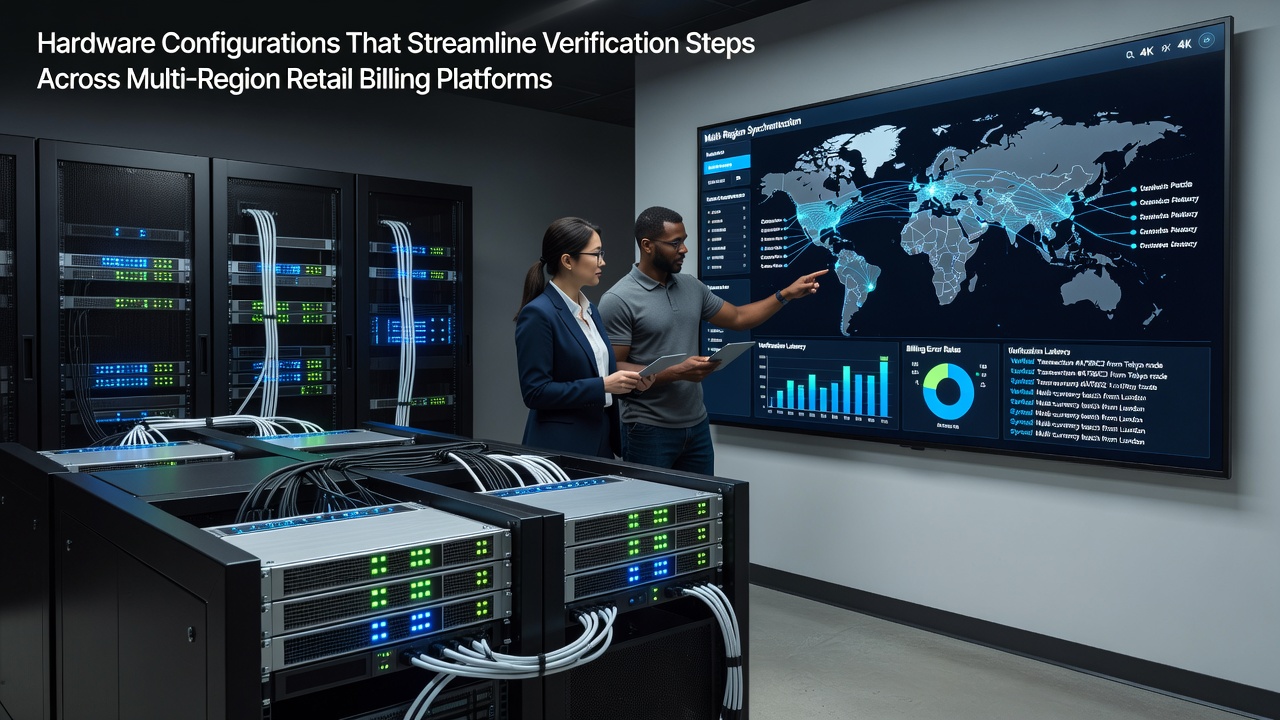 Retail billing platforms operating across multiple regions rely on hardware configurations that reduce verification latency while maintaining compliance with varying regulatory requirements, and these setups combine localized processing units with centralized security appliances to handle transaction checks efficiently. Observers note that companies deploy hardware security modules in each regional node to perform cryptographic verifications without routing every request back to a single headquarters location, and this approach cuts down on round-trip times that can exceed acceptable thresholds during peak shopping periods. Data centers equipped with specialized verification servers use field-programmable gate arrays to accelerate signature validations and token checks, while the same servers maintain compatibility with regional payment protocols through modular firmware updates.
Regional Node Architectures and Their Role in Verification
Hardware architects design regional nodes around a combination of high-throughput network interface cards and dedicated verification processors, and these components work together to authenticate billing requests locally before they reach the core platform ledger.
Engineers integrate trusted platform modules directly into the server motherboards of each node, allowing immediate hardware-rooted identity checks that comply wth standards updated in June 2026, and this integration eliminates software-only bottlenecks that previously delayed multi-region rollouts.
Studies from research institutions such as the National Institute of Standards and Technology show that nodes configured with paired verification appliances reduce false-positive rates in cross-border billing by routing suspicious transactions through secondary hardware filters before escalation.
Edge Computing Devices Supporting Localized Checks
Retail environments increasingly incorporate edge devices that perform initial verification steps at the point of sale, and these compact units contain secure elements capable of validating customer tokens against regional blacklists without constant cloud connectivity.
Technicians configure these devices with dual-SIM capabilities and region-specific certificate stores, which enables seamless handoffs when a transaction crosses from one regulatory zone into another, and the hardware maintains persistent logs that feed into centralized analytics platforms for audit purposes.
Industry reports indicate that edge hardware equipped with the latest secure element chips processes verification requests up to forty percent faster than legacy terminal configurations, and this speed advantage becomes particularly noticeable during seasonal sales events that span multiple continents.

Interconnected Verification Appliances and Load Distribution
Verification appliances deployed across regions connect through dedicated fiber links that prioritize latency-sensitive traffic, and load balancers at each site direct incoming billing requests to the nearest available hardware module based on real-time health metrics.
These appliances run hardened operating systems that support live migration of verification sessions, allowing operators to shift workloads during maintenance windows without interrupting ongoing retail transactions, and the underlying hardware includes redundant power supplies and RAID-configured storage arrays to prevent single points of failure.
Figures from the European Network and Information Security Agency reveal that platforms using synchronized appliance clusters achieve verification completion times averaging under two hundred milliseconds across tested regions, and this performance holds steady even when traffic volumes increase by three hundred percent.
Security Module Placement and Compliance Alignment
Placement of hardware security modules follows a distributed model that aligns with local data residency rules, and each module stores only the cryptographic material required for its assigned region while maintaining encrypted channels to a master key vault located in a neutral jurisdiction.
Engineers test these configurations against evolving standards that take effect in June 2026, ensuring that verification hardware can accommodate new elliptic curve algorithms without requiring full replacement of existing server racks, and the modular design allows incremental upgrades through field-replaceable interface cards.
Retail operators who have adopted this approach report fewer compliance audits triggered by cross-region data transfers, because verification occurs at the hardware level within each jurisdiction before any aggregated data leaves the region.
Conclusion
Hardware configurations that streamline verification across multi-region retail billing platforms continue to evolve as new processor architectures and secure element standards become available, and organizations that map their node placements to both performance requirements and regulatory boundaries achieve measurable reductions in processing delays.
Ongoing deployments demonstrate that combining regional verification appliances with edge devices and properly positioned hardware security modules creates a resilient foundation capable of supporting expanding retail networks, and these setups maintain consistent verification integrity even as transaction volumes and geographic coverage increase.