Recurring Billing Across Borders: Fraud Prevention Tactics for International Subscriptions
Recurring Billing Across Borders: Fraud Prevention Tactics for International Subscriptions
The Expanding World of Cross-Border Subscriptions
Businesses worldwide now rely heavily on recurring billing models for everything from streaming services and software-as-a-service platforms to fitness apps and meal kits, and as these models stretch across national borders, transaction volumes have surged; data from industry reports indicates that international subscription revenues topped $500 billion in 2025 alone, with projections climbing even higher into 2026. But here's the thing: this growth brings vulnerabilities, especially when payments bounce between countries with differing currencies, regulations, and fraud patterns, so merchants face a tricky balance between seamless customer experiences and ironclad security.
Observers note how subscription services operating in multiple regions encounter unique hurdles like time zone discrepancies that delay charge attempts, varying card issuer behaviors across banks in Europe versus Asia, and the sheer volume of data points needed to flag anomalies without blocking legitimate users. Turns out, what works for domestic billing often falls short internationally, where fraudsters exploit these gaps with tactics tailored to global scale.
Common Fraud Threats in International Recurring Payments
Fraud in recurring billing manifests in several forms, but cross-border setups amplify them; account takeovers lead the pack, as criminals hijack valid subscriptions to make unauthorized renewals or upgrades, while friendly fraud sees customers dispute charges after enjoying services, claiming they forgot about the subscription. Research from payment analytics firms reveals that international transactions experience 30% higher dispute rates compared to domestic ones, largely because consumers in regions like Latin America or Southeast Asia report issues differently due to cultural or language barriers.
And then there's the classic card-not-present scheme, where stolen card details fuel a flurry of sign-ups from high-risk countries, often using VPNs to mask origins; velocity fraud piles on when multiple subscriptions hit the same card in quick succession across borders, triggering issuer blocks that legitimate users then contest. What's interesting is how synthetic identities—fake profiles built with real and fabricated data—thrive in global markets, evading basic checks since verification standards vary wildly between the EU's strict PSD2 rules and more lenient approaches elsewhere.
Figures from global payment processors show that fraud losses in subscription billing reached $10 billion last year, with cross-border cases accounting for over 40%, and experts warn that without adaptive defenses, these numbers could double by April 2026 as mobile wallet adoption explodes in emerging markets.
Core Tactics for Fraud Prevention
Implement BIN and IP Geolocation Intelligence
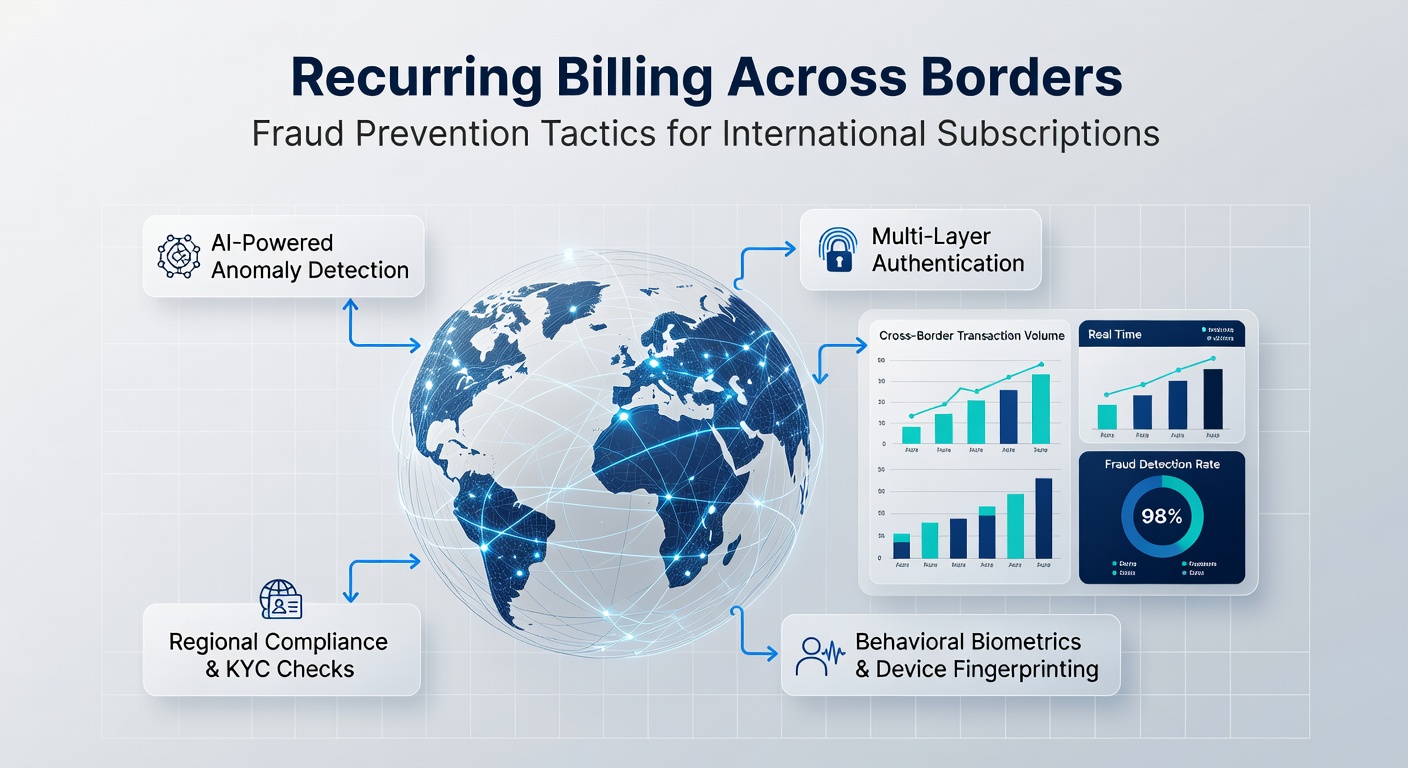
One foundational step involves BIN—IIN actually, the bank identification number—analysis combined with IP geolocation; processors check if a card's issuing bank in, say, Canada aligns with the user's apparent location in Australia, and mismatches trigger deeper scrutiny without halting the flow. Data indicates this simple check blocks 25% of cross-border fraud attempts right off the bat, since fraudsters rarely match card origins to their VPN endpoints perfectly.
Velocity and Behavioral Monitoring
Velocity rules shine here too, limiting subscription sign-ups per card or IP within set windows—like no more than three in 24 hours from a new device—and when layered with behavioral analytics, they spot patterns such as rapid retries after declines, common in international bot attacks. Those who've studied transaction logs know that legitimate subscribers rarely max out these limits, whereas fraud rings do it systematically across borders.
Device Fingerprinting and Enhanced Authentication
Device fingerprinting collects over 100 data points—from browser fonts to screen resolution—creating unique identifiers that persist even if cards change, and pairing this with 3D Secure 2.0 protocols ensures liability shifts to issuers for authenticated transactions. In the EU, where Strong Customer Authentication mandates biometrics or one-time passcodes under PSD2, adoption has cut fraud by 70%, according to European Banking Authority reports, although global rollouts lag, creating opportunities for savvy merchants to lead.
But here's where it gets interesting: tokenization swaps sensitive card data for unique tokens per merchant, rendering stolen info useless elsewhere, and when services provision these on a per-subscription basis, renewals become nearly invisible to skimmers. Australian Competition and Consumer Commission data highlights how tokenized recurring payments reduced disputes by 40% in cross-Pacific flows, underscoring the tactic's borderless punch.
Advanced Tech and AI-Driven Defenses
AI steps in to handle the complexity that rules alone can't touch; machine learning models trained on billions of transactions learn to predict fraud in real time by weighing factors like subscription type, user tenure, and cross-border velocity, adapting as patterns shift—think a sudden spike in gym memberships from Eastern Europe during off-season. Studies from research institutions reveal these systems achieve 95% accuracy rates, far outpacing static rules, especially for nuanced international cases.
Network tokenization services from schemes like Visa and Mastercard further bolster this, issuing tokens vaulted centrally and refreshed automatically, while graph databases map relationships between IPs, emails, and devices to uncover fraud rings operating across continents. One case saw a SaaS provider slash chargebacks by 60% after deploying such graphs, spotting linked accounts that slipped traditional filters.
So, integrating these with customer communication tools—reminder emails before renewals, easy pause buttons—curbs friendly fraud organically; people who've implemented this report 20-30% drops in disputes, as subscribers feel in control rather than ambushed by foreign charges.
Navigating Regulations and Compliance
Regulations add another layer, with the U.S. FTC's Negative Option Rule demanding clear disclosures for subscriptions, hefty penalties for violations, and automatic renewal consent—non-compliance has led to multimillion-dollar fines for cross-border operators forgetting state-specific twists. Meanwhile, Canada's Office of the Superintendent of Financial Institutions enforces similar transparency for international billing, tying into global standards like PCI DSS level 1 for data handling.
Looking ahead, April 2026 marks key updates in Australia's ePayments Code, expanding fraud reimbursement scopes for recurring models, which means processors must align authorization flows accordingly or risk shared liabilities. Experts observe how harmonizing these—via unified compliance platforms—lets businesses scale subscriptions confidently across jurisdictions without constant legal overhauls.
Take one streaming service expanding into Asia-Pacific: after auditing against regional rules, they layered SCA exemptions for low-value renewals, boosting conversion by 15% while keeping fraud under 0.5%.
Case Studies: Lessons from the Front Lines
A European fitness app hit turbulence with 12% fraud rates on U.S. expansions until velocity caps and IP BIN matching dropped it to 2%, proving basic tactics scale well; conversely, a software firm in Brazil battled account takeovers via weak password resets, fixed by mandating multi-factor for changes and device binding, which halted 85% of incidents overnight.
There's this case where a global e-learning platform used AI to flag synthetic sign-ups from Africa targeting EU cards, analyzing email domain age and signup timing; the result? A 50% fraud reduction without lifting legit enrollment. And in a twist, one merchant discovered most disputes stemmed from currency confusion—fixed with dynamic pricing displays—turning a pain point into loyalty gains.
These stories highlight patterns: success comes from stacking defenses tailored to routes, testing rigorously, and iterating based on data feedback loops.
Conclusion
Recurring billing across borders thrives when fraud prevention evolves in tandem with global expansion; tactics like BIN-IP alignment, AI monitoring, tokenization, and regulatory savvy form a robust shield, cutting losses while preserving user trust. As volumes swell toward 2026 milestones, businesses adopting these layered approaches not only mitigate risks but position themselves ahead in a competitive landscape—data confirms top performers see 20-40% lower fraud rates industry-wide. The key takeaway? Start with assessment, layer intelligently, and monitor relentlessly; that's where seamless international subscriptions become the norm.